Applications:
- Individual households
- Residential societies
- Farmhouses & rural homes
- Hostels, schools & small canteens
- Organic kitchens & eco-homes
- Individual homes
- Farmhouses
- Small canteens
- Organic & eco-friendly kitchens
Construction Details:
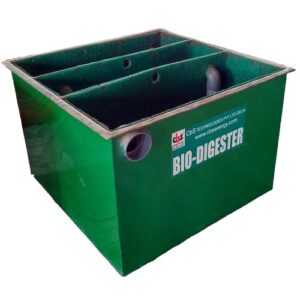
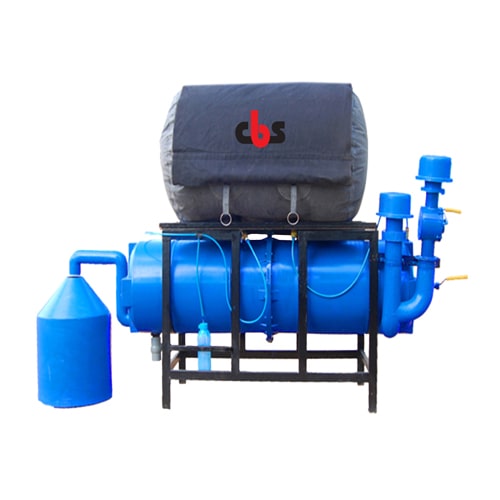
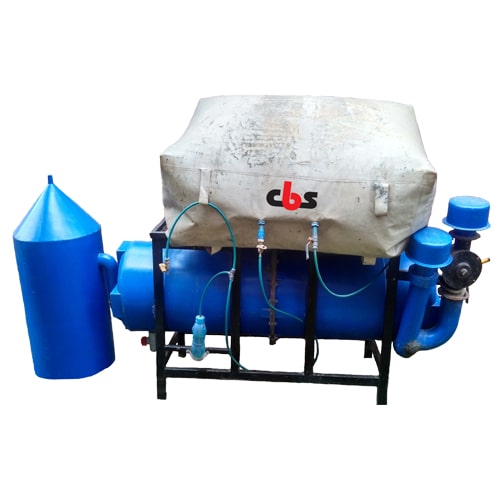
- Reactor Body: Corrosion-resistant polymer / FRP / MS (as per model)
- Inlet System: Waste feeding chamber with safety lid
- Gas Outlet: Standard biogas pipeline connection
- Slurry Outlet: Gravity-based discharge
- Sealing: Gas-tight construction
Installation & Operation:
- Installation Type: Floor-mounted / ground-mounted
- Installation Time: 1–2 hours
- Operation: Semi-automatic / manual feeding
- Maintenance: Very low; no re-addition of bacteria required
Safety & Compliance:
- Low-pressure system for domestic safety
- Non-toxic, eco-friendly process
- Suitable for urban & rural environments
Frequently Asked Questions (FAQs)
Q1. What is a Domestic Bio-Gas Reactor?
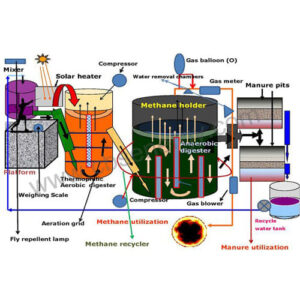
A system that converts kitchen and organic waste into biogas and organic manure.
Q2. What type of waste can be used?
Kitchen waste, food leftovers, and biodegradable organic waste.
Q3. Where can it be installed?
Homes, apartments, farmhouses, hostels, and small canteens.
Q4. Is it safe for domestic use?
Yes, it operates at low pressure and is completely safe.
Q5. Does it produce bad smell?
No, it is a sealed, odour-free system.
Q6. How much maintenance is required?
Very minimal; no manual scavenging or re-addition of bacteria.
Q7. Can the gas be used for cooking?
Yes, the generated biogas is suitable for cooking and heating.
Q8. What happens to the leftover slurry?
It can be used as nutrient-rich organic manure.
Q9. Does it save money?
Yes, it reduces LPG consumption and waste disposal costs.