
Hydrocyclone Basin Sweeping System in collaboration with Dutch Technology
Cooling tower basins and process water tanks are prone to the accumulation of solids such as airborne dust, sand, algae, and corrosion byproducts. Left unchecked, this sludge promotes biological growth (including Legionella), reduces heat transfer efficiency, and accelerates under-deposit corrosion.
The CBS Technologies Basin Sweeping System is an engineered solution that continuously removes these settled solids without requiring process shutdown or manual cleaning. By combining high-efficiency Hydrocyclone Separators with a strategic Eductor Nozzle Sweeping network, we ensure your basins remain sludge-free and your water quality remains optimal.
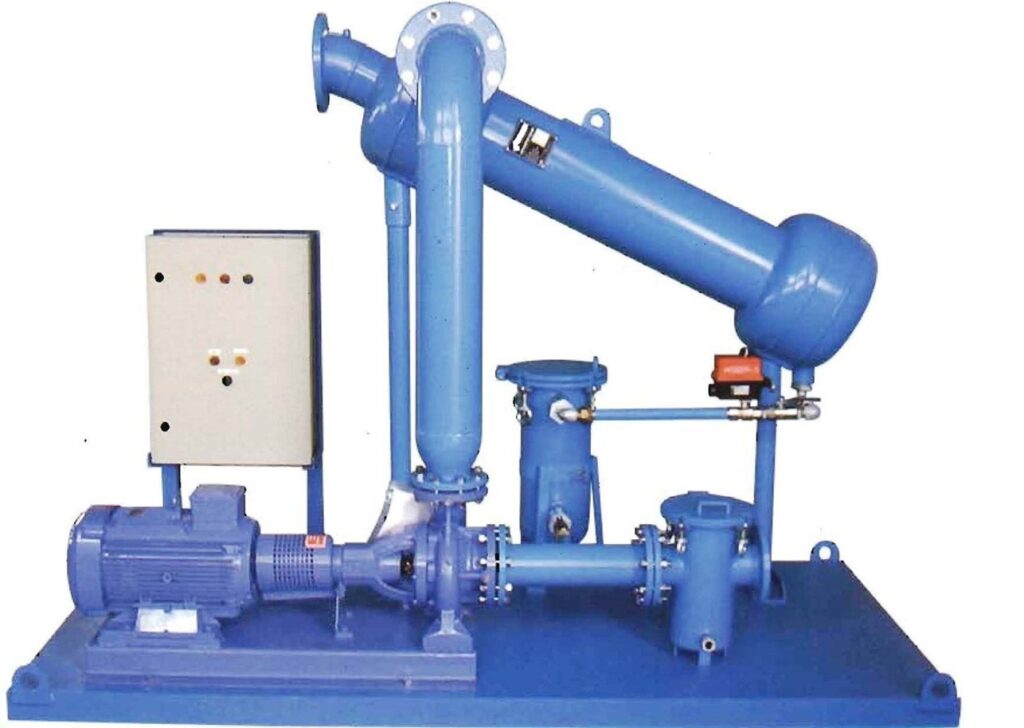
The Technology: How It Works
Our system operates on a continuous recirculation loop designed to keep solids in suspension and direct them toward the filtration unit.
- The Filtration Core: Hydrocyclone Separators
At the heart of the system is the Hydrocyclone. It utilizes centrifugal force to separate solids from liquid. - Tangential Inlet: Water enters the cyclone at a high velocity tangentially.
- Vortex Generation: This creates a powerful centrifugal force (up to 2000 G-force), spinning the water down the cone.
- Separation: Heavier solids are spun to the outer wall and spiral down to the purge chamber.
- Clean Water Recovery: The cleaned water reverses direction at the bottom and spirals up the center to the outlet.
The Sweeping Mechanism: Eductor Nozzles
Filtration is useless if the dirty water doesn’t reach the filter. We install a network of Eductor Nozzles on the basin floor.
a. These nozzles utilize the Venturi effect.
b. For every 1 volume of pressurized water pumped through the nozzle, they entice 5 volumes of surrounding basin water.
c. This creates a high-volume “sweeping” current that pushes settled sludge toward the system’s suction intake.
System Process Flow
a. Suction: The recirculation pump draws water loaded with solids from the collection sump (the lowest point where nozzles direct the debris).
b. Filtration: The pump pushes water through the CBS Hydrocyclone. Solids are separated and purged.
c. Return & Sweep: The clean water is piped back into the basin through the Eductor Nozzles.
d. Cycle: The pressurized return water drives the nozzles to sweep more debris toward the suction, creating a continuous cleaning loop.
Key Features & Benefits
| Feature | Benefit |
| No Moving Parts | The Hydrocyclone has no internal moving parts, resulting in zero mechanical wear and minimal maintenance. |
| Continuous Operation | The system cleans while the cooling tower/process is online. No downtime required for basin cleaning. |
| Water Conservation | Unlike sand filters that require backwashing, hydrocyclones use very little water for purging solids. |
| Biological Control | By removing the sludge “habitat” for bacteria, the risk of Legionella and bio-fouling is drastically reduced. |
| Energy Savings | Cleaner heat transfer surfaces (chillers/exchangers) mean better efficiency and lower energy bills. |
Technical Specifications
1. Filtration Efficiency: Removes 98% of solids heavier than water down to 40-70 microns (depending on specific gravity).
2. Operating Pressure: 1.5 bar to 3.5 bar (optimal pressure drop required for vortex efficiency).
3. Material of Construction:
– Hydrocyclone: Carbon Steel (Epoxy Coated), Stainless Steel (304/316), or Glass-Filled Nylon.
– Piping: PVC, CPVC, or SS.
– ** purge Options:** Manual Ball Valve, Motorized Valve (Timer based), or Continuous Bleed.
Typical Applications
1. Cooling Tower Basins: HVAC and Industrial cooling loops.
2. Steel Mills: Scale pit cleaning and quench water filtration.
3. Automotive Paint Shops: Sludge removal in phosphate baths.
4. Municipal Water: Grit removal pre-filtration.
Why Choose CBS Technologies?
At CBS Technologies Pvt Ltd, we don’t just sell filters; we design flow dynamics. A basin sweeping system requires precise calculation of nozzle spacing, pump head, and flow rates to ensure no “dead zones” are left in the basin.
“Stop cleaning your basin manually. Let the water clean itself.”